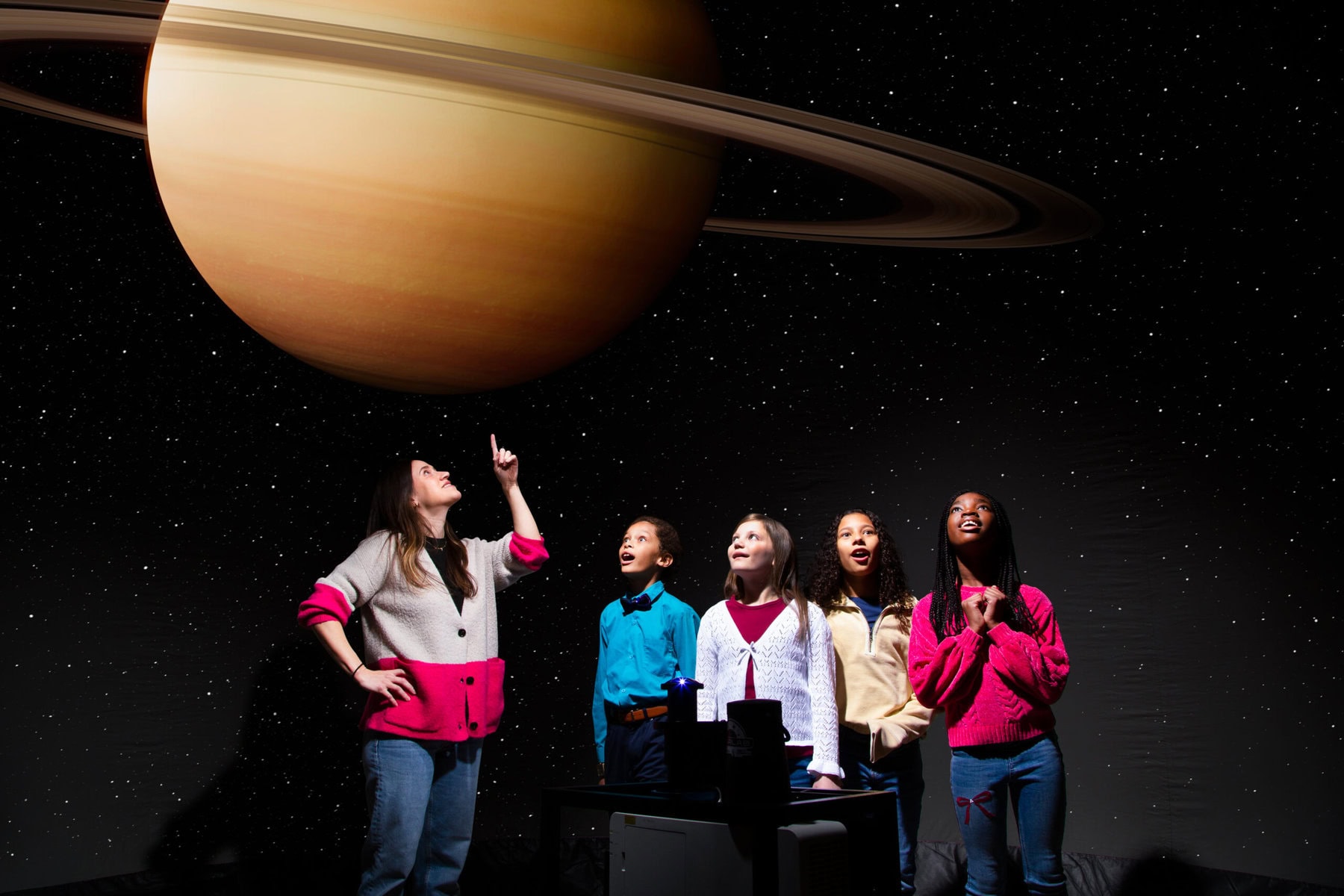
Starlab is a portable, inflatable learning dome that turns any classroom, gym, or community space into an immersive learning experience in astronomy, earth science, meteorology, and more. The dome gets the attention, but the real value is what’s running underneath it: every lesson is mapped directly to Next Generation Science Standards (NGSS), so a teacher can walk in, pick a lesson, and deliver standards-aligned instruction without building content from scratch or needing a science degree to pull it off.
Earth and space science has a way of getting squeezed in elementary and middle school. Not because kids find it boring. Most don’t. It’s more that teaching a solar eclipse, a moon phase cycle, or a shifting weather front convincingly takes specialized equipment, a field trip budget, or a teacher who feels genuinely confident in the content. A lot of elementary generalists may not have any of the three.
That’s the gap standards-aligned curriculum is supposed to close. Problem is, “standards-aligned” gets thrown around so often in K-12 marketing that it’s hard to know what that means.
So we’re getting specific. Below, we’ll walk through:
- What NGSS alignment actually looks like inside real Starlab lessons
- Three lessons, broken down standard by standard
- How schools like PS 212 in Queens and Christa McAuliffe Elementary in Palm Bay are already using this in practice
What Happens When Teachers Are Stretched Thin
Here’s an uncomfortable truth: elementary science is often the first subject cut when time runs short.
A 2025 study in School Science and Mathematics tracked how elementary teachers in North Texas decide, day to day, whether to teach science at all. The researchers didn’t soften the finding. Their title says elementary science instruction is “nearing extinction” in a lot of classrooms.
The same study points to a training gap behind that decision. Citing Horizon Research survey data, it notes that only about a third of elementary teachers report taking coursework across all three major science disciplines: Earth, life, and physical science, combined.
That hits Earth and Space Science especially hard. It’s often the discipline furthest from a generalist’s comfort zone. Explaining why the moon changes shape, or how a cold front collides with a warm one, takes a level of content confidence a lot of teachers just weren’t trained to have.
Reading a worksheet about plate tectonics is one thing. Fielding a room full of follow-up questions about it is another.
This is the real case for a tool like Starlab. Not “kids love the dome” (though they genuinely do).
The stronger case: pre-built, standards-aligned scripts hand a teacher content expertise they might not have had time to build, while still hitting the exact performance expectations their district is accountable for.
What “Standards-Aligned” Means in Starlab
A few things, specifically:
- Every lesson maps to a current NGSS performance expectation, across astronomy, geology, meteorology, and more.
- The library is deep, not thin. More than 25 geology lessons and 40+ meteorology lessons, plus a full astronomy program running from our own solar system to deep space
- Nothing requires internet access to run. That matters more than it sounds. A lot of rural and under-resourced schools can’t count on reliable connectivity, and a standards-aligned lesson that stalls out on a dropped signal isn’t much of a lesson
- The interface is built for speed. Browser-like navigation means a teacher can find and launch a lesson without digging through folders or manuals
Bottom line for a STEM leader or principal evaluating this: you’re not asking a teacher to become a part-time astronomer. You’re asking them to press play on something a curriculum team already built, reviewed, and mapped to the standard.
Quick Reference: Four Standards, Four Lessons
| Grade Band | NGSS Standard | What the Standard Asks For | Starlab Lesson |
| K-1 | 1-ESS1-1 | Use observations of sun, moon, and stars to describe and predict patterns | Day & Night sessions |
| 3-5 | 5-ESS1-2 | Represent data on patterns caused by Earth’s rotation and orbit (day/night, shadows, seasonal star positions) | Patterns of Earth and Sky |
| MS | MS-ESS1-1 | Model the Earth-sun-moon system to explain lunar phases, eclipses, and seasons | Moon phases module |
| MS | MS-ESS2-5 | Collect data on how air mass motion and interaction drive weather changes | Weather systems module |
Three Lessons Up Close
1. Patterns of Earth and Sky (5-ESS1-2)
This fifth-grade standard is trickier than it looks. It doesn’t just ask students to describe what they see. It asks them to represent data: track shadow length and direction, note the timing of day and night, log which stars show up in different seasons, then connect all of it back to Earth’s rotation and orbit.
That’s exactly the unit PS 212’s fifth graders were mid-way through when their school was selected for a Starlab Days visit this year.
A quick bit of context on PS 212: it’s a Title I elementary school in Jackson Heights, Queens, serving around 550 students. Many are English Language Learners or in dual-language and special education programs. Science teacher Roslyn Macheras-Marte made the case in her nomination plainly: immersive experiences like Starlab are common in wealthier communities, and her students deserved one too.
For a unit built around observing sky patterns, stepping inside a dome that shows those patterns in motion turns an abstract data standard into something students can actually watch happen.
2. Sun, Moon, and Star Patterns (1-ESS1-1)
At the K-1 level, the standard reads simply: use observations to describe and predict patterns. Simple on paper. Still genuinely hard to teach without a night sky on demand.
Starlab’s Day and Night sessions are built for exactly this age group. One education coordinator summed it up well, noting how closely the pre-loaded Day and Night and planet sessions matched what teachers were already covering in class.
That’s standards alignment done right. The lesson isn’t a fun add-on that happens to brush against science. It’s the actual instruction, delivered in a format young students can process without having to imagine something they’ve never seen.
3. Weather Systems (MS-ESS2-5)
Middle school weather standards ask students to collect and interpret data on how air masses interact. That’s a lot easier to explain with a moving system in front of you than a static diagram.
Think about the questions this standard raises naturally:
- Why does a desert form in Antarctica despite the cold
- How does a hurricane actually form
- What does it look like when a warm front collides with a cold front
Starlab’s meteorology library, with 40+ lessons, lets students watch these systems develop and shift in real time inside the dome. That gives the standard’s emphasis on data collection and interpretation something concrete to work from, instead of a diagram frozen at one moment in time.
Why the Dome Changes the Delivery, Not Just the Content
There’s a difference between covering a standard and teaching it in a way students actually keep.
A 2024 systematic review in Frontiers in Education looked at immersive technology across STEM classrooms and found a consistent pattern: immersive, interactive formats tend to outperform static or lecture-based instruction on engagement, and in several studies, on performance too. That tracks with what districts using Starlab report anecdotally, but it’s worth knowing the research backs the instinct.
There’s an equity piece here too, and it’s easy to skip past.
A 2025 paper in Science Education on justice-centered informal STEM programming points out that access to immersive, hands-on science experiences tends to concentrate among students who are already white, English-speaking, and higher-income.
That’s a gap a few districts have used Starlab to close:
- Stockton Unified brought it into a district where light pollution and cost make traditional planetarium visits impractical for most students.
- PS 212 used it to give Title I, multilingual students an experience that is rare in this community.
- Christa McAuliffe Elementary tied its visit to the 40th anniversary of the Challenger disaster, connecting the school’s namesake and her mission to bring space education into every classroom.
None of that works, though, if the content underneath the dome isn’t built to hit the standards a district is accountable for. The immersion earns the attention, but the standards alignment is what makes the class period count toward instructional goals, not just a memorable field-trip-style day.
Real Classrooms, Real Standards Met
A quick snapshot of this playing out beyond a single lesson plan:
Stockton Unified School District Deployed Starlab specifically to address light pollution and cost barriers, while training a single point-of-contact teacher at each school for consistent implementation district-wide.
University of Illinois Extension’s 4-H program Uses Starlab with third through sixth graders across rural and urban Illinois, aligning astronomy content to NGSS while layering in mythology and storytelling to boost retention.
Across both, the pattern holds. The learning dome creates the moment. The standards alignment is what turns that moment into instructional time a district can actually point to.
Standards-aligned curriculum sounds like a spec sheet line item until you watch a fifth grader in Queens track the moon’s phases in real time, or a Title I district in California give its students a planetarium experience that used to require a field trip they couldn’t afford.
That’s the part worth remembering. The dome is what gets students to look up. The curriculum underneath it is what makes sure the standard actually gets taught and remembered.
FAQs
Is Starlab’s curriculum aligned to my state’s standards or just NGSS?
The core library is built against current NGSS performance expectations, which most states have adopted or adapted, often under a state-specific name like New Jersey’s NJSLS-S or Utah’s SEEd standards. Because most state standards closely mirror NGSS structure, alignment tends to carry over with minimal translation. We’re happy to walk through specifics for your state.
Do teachers need a science background to run a Starlab lesson?
No. Every lesson comes with a prepared script and guide, built so a teacher with no specialized science training can deliver it confidently. That’s the design intent, not an afterthought.
What grade levels does the curriculum library cover?
K through 12, with content that scales from simple pattern observation in early elementary to data-driven modeling in middle and high school.
How much prep time does a typical lesson take?
Minimal. Lessons come pre-built and pre-loaded onto the included laptop, so a teacher can select one and start teaching without building materials from scratch.
Can Starlab supplement existing curriculum or does it mean rebuilding what we already teach?
It’s built to supplement. Lessons are mapped to specific NGSS performance expectations, so they slot into a unit a teacher is already teaching rather than requiring a separate track.
How long does setup and breakdown take between sessions?
As little as 20 minutes for the dome itself. That’s part of why it works for districts moving Starlab between multiple schools or classrooms in a single day.