Starlab Grant Toolkit
Relevant Grant Opportunities
We’ve compiled a variety of government and corporate grants awarded to districts, schools and teachers across the country who are demonstrating a commitment to STEM education.
The Cliff Notes on Educational Grants
Writing a Winning Proposal
While each grant will have unique requirements, most require similar elements. So before even identifying a grant you’d like to apply for, it could be helpful to prepare responses for common elements of most proposals.
Organizational History:
- What is your school’s/district’s sense of call and purpose?
- What is your vision for Starlab at your school/in your district/within the community? How does it relate/differ to past STEM-related programming? Is Starlab part of a larger STEM initiative?
Program Objectives & Goals:
- What milestones are important to this program?
- Map out the details of your plan and exactly how the grant’s funding will be used. Share the quantifiable outcomes you’ll be measuring and the metrics you’ll be able to share with your funders: test scores, engagement levels, interest in STEM careers, etc.
- Tell a story with data. Paint a clear picture of how the funds from this education grant will transform your schools, students, and/or communities. Emphasize any underserved groups if applicable, and use data to build a compelling case that highlights the true need for these funds (lack of access, gaps in proficiency, etc.). You can also use data to support the vision of the improvements this STEM program will bring. Speak directly to the grantor and use the facts to make a genuine case for your school’s needs.
Program Participants Background:
- Who is impacted by your program?
- Add the voices from the community. Student testimonials, quotes, and anecdotes help tell your story with emotion and empathy. Put faces to the data to make your application resonate emotionally. Photos and videos are great additions to do this visually.
- Add third parties. Showcase any community partnerships, cross-sector collaborations, or matching funding sources. These all provide social proof and strengthen credibility, making the idea of your STEM program more attainable to the grantor looking at contributing funding.
- Biographies and qualifications for senior personnel involved
Program Evaluation:
- How will you monitor and evaluate the impact?
Program Budget:
- How will the funds from the grant be utilized?

Starlab Positioning Statements & Descriptions
We’ve put together some background and information you can use as a starting point for your Starlab grant applications.
An Overview of Starlab
In 1977, in a room full of middle school students in Lincoln, Massachusetts, Philip Sadler invented the world’s first portable learning dome—Starlab. Since then, Starlab has engaged, inspired, and excited countless audiences—from K-12 students to adults of all ages and from all walks of life. Today, Starlab is proud to be the most widely used and recognized portable learning dome in the world.
Built by a team of scientists, technologists, and educators, Starlab’s mission is to empower scientific literacy by inspiring curiosity, promoting lifelong learning, and fostering a deep appreciation for our universe and everything within it.
What Makes Starlab Different
Starlab is the leading portable planetarium offering the sharpest, highest quality imagery possible to transport students into a world of planetary exploration. Unlike the digitally simulated 4K pixel-shift of other projectors, Starlab’s native 4K projector can generate detailed images, so students can easily visualize the details of our vast universe. For over 30 years, Starlab has been used in thousands of districts, schools, and science centers across the country, empowering teachers to provide the most interactive learning experience possible for students. StarLab has served to expand access to a fully immersive learning experience and build growing student interest in STEM-related disciplines.
Built by a team of scientists, technologists, and educators, Starlab’s mission is to empower scientific literacy by inspiring curiosity, promoting lifelong learning, and fostering a deep appreciation for our universe and everything within it.
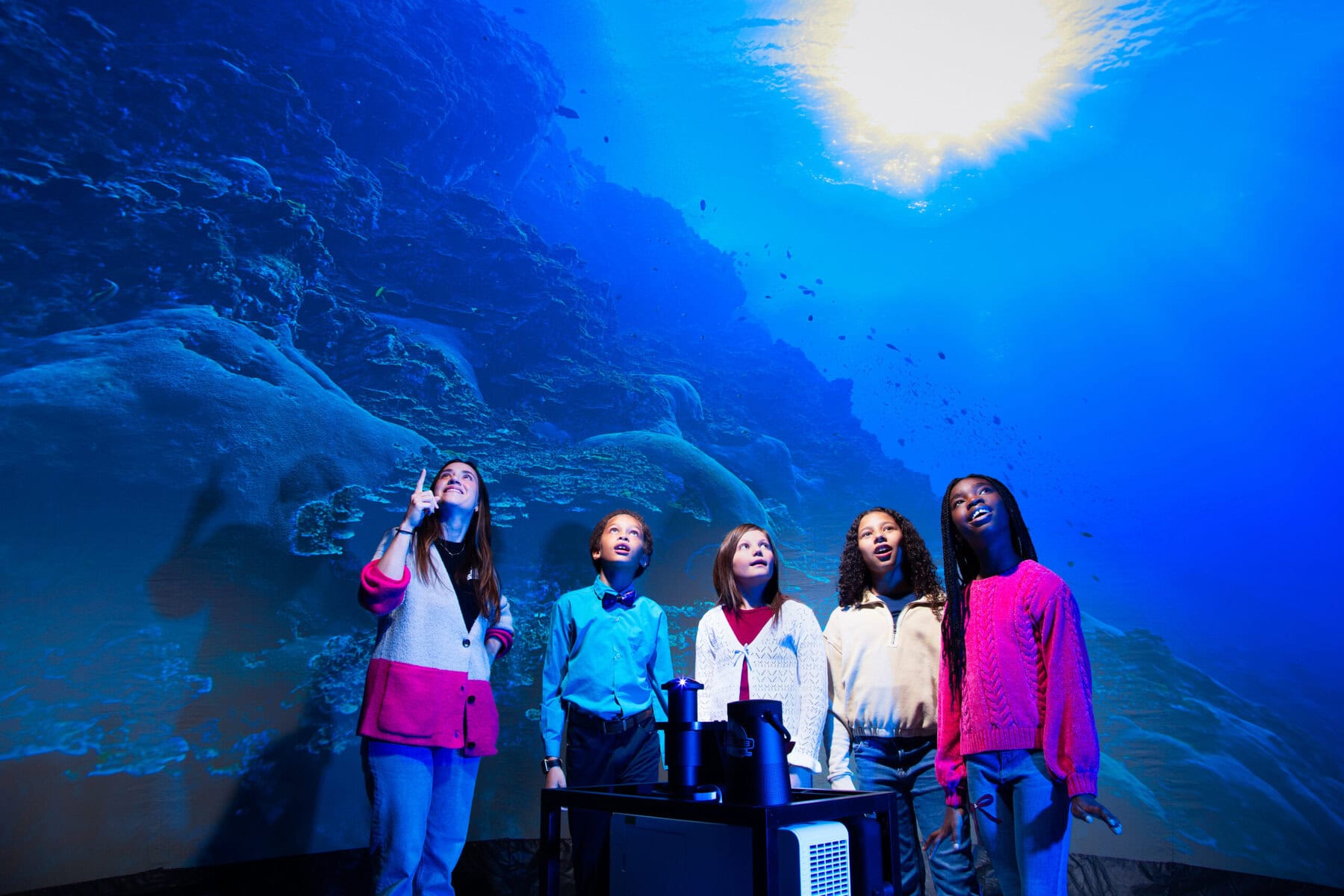
With a lightweight, simplified case design and streamlined setup, teachers can bring any astronomy, geology, meteorology, and geography lesson to life in under 15 minutes. For phenomena that are challenging or even impossible to experience in real life, Starlab with a 4K projector provides teachers with an opportunity to help students observe the unobservable up close, creating an immersive learning experience that results in stronger student engagement and a deeper, more authentic understanding of concepts.
Positive Outcomes of Starlab
More than just cutting-edge technology, Starlab is an initiative to build the scientific literacy skills students will need in the future, empower them with experiences that widen their perspective, and deepen their learning in ways that can help close learning gaps. What’s more, Starlab is an initiative that demonstrates a clear commitment to expanding programming and access to science education for all students.
Consider the experience for students in the SUSD. In an urban environment, where many Stockton schools are located, light pollution and high poverty rates prevent many students from observing the skies or traveling to locations where such observation is possible. As a result, many concepts around space and astronomy remain nebulous and hard for students to understand. For the district, this was an opportunity to address the gap by creating a more immersive learning experience that helps students engage with and understand complex subjects. SUSD used StarLab to deliver a fully immersive learning experience to more than 12,000 students, generating the sharpest images possible so students could easily visualize the details of our vast universe and more easily connect concepts from instruction to the real world.
Further, studies from the Education Commission of the States suggest that schools that strategically invest in STEM resources, like Starlab, see improved student outcomes in science and math. This research highlights several key benefits:
Key Benefits of STEM Resources

Enhanced Curriculum and Instruction

Professional Development for Teachers
Investing in science initiatives helps teachers gain the skills needed to effectively teach STEM subjects. Programs that focus on increasing teachers' content knowledge and pedagogical skills can lead to better student performance in STEM areas. See how Fairmont State uses Starlab to support and prepare area teachers.

Access to Resources and Technology
Specific Examples of Starlab’s Impact
Increasing access and expanding scientific literacy community wide in the Stockton Unified School District
In support of California's recent move to add science assessment and scores to the California School Dashboard, SUSD looked to expand STEM programming and increase access to science education for all students in the district. To support these goals, Stockton invested in six new StarLabs, portable learning domes designed to bring astronomy, geology, meteorology, and other STEM subjects to life for students.
With the ability to advance STEM education across grade levels and curricula aligned to the Next Generation Science Standards, StarLab would create fully immersive learning experiences for more students, deepen their understanding of the world around them, build growing interest in STEM-related disciplines, and expand scientific literacy skills across its student population.
22
Of its 42 schools, 22 used StarLab in 2023-24
11,633
Students who experienced Starlab
1,000
Adults who experienced Starlab
12,633
Total people experiencing Starlab
- Increasing scientific literacy throughout the community
In addition to using it as part of classroom curriculum, Starlab serves as a central element of STEAM Fairs for Stockton’s local communities, where district community members of all ages can experience Starlab. During the 15-minute Starlab experience, people are immersed in an out-of-this-world learning adventure. From experiencing an eclipse up close to seeing our return to the moon, people explore the far-away wonders of our universe right before their very eyes, expanding interest in STEAM-related subjects for all members of the community. Starlab makes peoples' experiences of viewing the night sky, traveling through space, and learning about Earth's processes as memorable and effective as a field trip to any big city science center or museum.
Improving K-12 teacher effectiveness at FSU’s NASA Educator Resource Center
The University’s Educator Resource Center (ERC) promotes NASA IV&V’s vision by expanding opportunities for West Virginia’s science, technology, engineering, and mathematics students and educators. To that end, the ERC trains pre-service and in-service elementary and middle school teachers on West Virginia’s science content standards so they can enhance their instructional techniques and feel confident teaching STEM-based disciplines. The ERC has used StarLab for over two decades to support this goal, hosting teacher workshops, providing trained teachers with access to StarLab, and facilitating StarLab experiences for students and the broader community.
StarLab’s Impact Across West Virginia: 48 of the 55 counties in West Virginia have used StarLab

Key Benefits of Starlab
- Ability to teach any subject from astronomy and meteorology to geology and history with turnkey curriculum aligned with NGSS standards that apply across grade levels
- Easy to use for any teacher--very little technical skill or training required
- State-of-the art technology: 4K projector & 190 degree lens generates the sharpest images possible
- Increases access: Simplified, lightweight case design for easy portability and quick setup for easy sharing across schools and communities
- Community outreach: Ability to extend the experience to other members of the community, engaging students and their families
- Improves equity: Levels the playing field with immersive learning experiences for students who otherwise don’t have the means or opportunity to visit planetariums
- Closes the learning gap created by the impact of COVID
- Longevity: The durability of Starlab means it lasts for decades, creating longevity for the initiative
- Inclusiveness: As a more inclusive approach to learning, Starlab lends itself well to students’ diverse backgrounds, physical abilities, and learning needs, providing a heightened level of immersion and interactiveness.